

What is an Immigrant Petition?
An immigrant petition is a document that allows you to ask or appeal to the United States government for permission to live in the country. It can be completed on your behalf by another person, such as an employer or a relative, or it can be done by you yourself.
Family Petition
An immigrant petition is a legal document that allows a family member to live and work in the United States. It’s a process that involves submitting forms and documents to USCIS, which reviews them and makes a decision on whether or not to approve them. It is a long and complicated process, so it’s best to have a skilled immigration attorney by your side to help you navigate through it successfully.
In the United States, family petitions are among the most common forms of immigrant visas. They are usually submitted for a close relative, like a spouse, parent, or child. However, they can also be filed for other family members, such as a step-parent.
The main goal of a family visa is to bring family members together and reunite them. But it can also be a way for you to secure your future in the United States.
A family visa can be secured through either consular processing or adjustment of status. Consular processing is the most common path to a green card, but some families prefer to file for their children through an adjustment of status instead.
Adjustment of status is a form of immigration law that allows an individual to adjust their status to permanent resident (green card) while in the United States. It’s essentially the same process as an immigrant visa, but there are a few differences.
Applicants for this type of visa do not have any numerical limits, so they will receive their Green Cards as soon as the petition is approved. This is a much quicker process than filing for a Preference Relative Visa, which can take months or years to complete.
Another benefit of a family visa is that your loved one can bring their spouse and unmarried children under 21 years of age with them to the U.S. This is a great way to ensure that they are not separated from their family while they are waiting for their immigrant visas.
But while the family visa process is a positive thing, it can be a frustrating and confusing one as well. It can take a lot of time and money to get your family member’s petition approved, and you might not know exactly how long it will take. Especially with so many other applications being processed at the same time, delays and backlogs can be hard to keep track of.
Employment Petition
An immigrant petition is a form of legal document that can result in an individual’s permanent residency in the United States. It is a complex process that requires the services of a professional immigration attorney to ensure all of the necessary steps are taken and met.
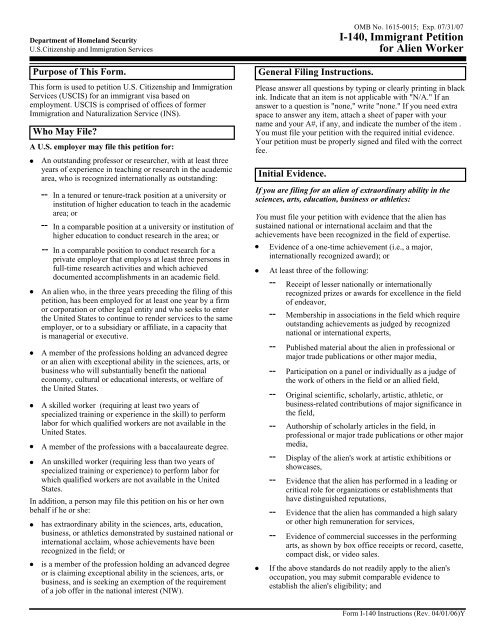
Those seeking employment-based green cards must first obtain labor certification approval from the Department of Labor (DOL). Once this is obtained, an employer files an I-140 Immigrant Worker Petition with the U.S. Citizenship and Immigration Services (USCIS).
Employers must provide proof that the prospective employer is able to pay the proffered wage, a requirement that can be difficult for many employers to meet. For this reason, many employers rely on the services of an experienced immigration lawyer to help with the documentation.
In addition, an employer may need to submit proof that it has sufficient funds to support the foreign worker and their family for at least a year before the employment-based visa will be approved. This can include profit/loss statements, bank account records and other evidence that shows the financial ability of the organization to pay wages in the United States.
Additionally, an employer can only use a foreign worker for the position that was offered in the PERM application and can only hire that person for the duration of the PERM certification period. If an employer does not hire the foreign worker for the full duration of the PERM certificate, he or she must apply for an extension and pay the appropriate fee.
Another common method of hiring a foreign worker is to use a H-1B or other non-immigrant visa. These are available for persons who wish to come to the United States to perform jobs that do not have enough qualified workers in the United States.
This is one of the most popular ways to immigrate to the United States. However, it is important to understand that an employment-based visa cannot be issued until the priority date of the applicant matches up with the annual numerical limit in the applicable category.
In addition, if an employer is a corporation, it must have been in existence for at least two years before filing an employment-based petition. During this time, it must have employed at least 100 people in the United States. The company must also be in good standing with the Better Business Bureau and must not have been cited for any violations of federal or state law.
Fiance Petition
An immigrant petition is the process of bringing a foreign citizen to the United States. It is used for spouses, parents, and children who want to become legal permanent residents.
A fiance petition, also known as a K-1 visa petition, is one type of immigrant petition that allows a foreign citizen to marry a U.S. citizen while in the United States. It is a short-term visa, which must be used within 90 days of entering the country, and a fiance can only marry the person who submitted the K-1 visa petition.
The US citizen sponsors the fiance by filing a form called Form I-129F, Petition for Alien Fiance. The form contains a statement that the couple intends to marry within 90 days of their admission into the United States. It is important to note that this must be a true and honest statement. If the marriage does not take place within this time frame, the visa holder can no longer remain in the United States as a fiance.
Once the Form I-129F has been approved, it is sent to the National Visa Center (NVC), which then forwards the application to the embassy or consulate nearest the fiance’s foreign home. The embassy or consulate then invites the fiance to an interview to confirm that the couple’s relationship is legitimate.
During the interview, the Consular Officer asks the fiance several questions to determine if the relationship is genuine. If the fiance is applying for a K-2 visa, which allows him or her to bring his or her unmarried minor children to the United States with them, the children must attend the interview as well.
After the K-1 fiance has married the US citizen, he or she can apply for an adjustment of status, which grants the fiance a green card that allows him or her to live in the United States permanently. The process is similar to that of applying for a spouse visa, except the fiance must wait until he or she has been married for four months before he or she can begin the adjustment of status application.
Petition for Alien Relative
An immigrant petition is a form submitted by U.S. citizens and lawful permanent residents (LPRs) that establishes their relationship to an eligible relative who wishes to immigrate to the United States and obtain a Green Card. The form is used to file for a number of different relatives, including spouses, children, and parents.
The process for filing an immigrant petition can take several months to a year, depending on the type of petition and the circumstances of the applicant. This process typically begins with the submission of the Form I-130, Petition for Alien Relative to USCIS.
Once the petition is filed, a notification will be sent to you. This will contain a 10-digit receipt number that you can use to check the status of your application online.
You will also be notified if any documents or additional information are needed to process the application. Normally, you will hear from USCIS within two to four weeks of submitting your Form I-130.
In some cases, you will be contacted and asked to attend an interview with USCIS. During this process, your relative will be evaluated and a decision to approve or deny their immigration petition may be made. Generally, it is expected that most relatives are approved at this stage for a green card.
The next step is to submit the petition with all required supporting documentation. This can include copies of your family and employment documents, proof of your identity, and other forms.
This part of the petition is a bit tricky, so it may be helpful to have a professional attorney help you complete it. A lawyer can ensure that all of the required forms are filled out and filed correctly.
Alternatively, you can download the form from the website of USCIS and fill it out by yourself. Make sure to follow the instructions carefully and fill out all the necessary fields correctly.
You will need to fill in your first name, last name, and address. Then, enter each of your family members’ names and their ages. It is important to enter the correct names of all your family members, as USCIS can deny your application if they find any of these names are incorrect or missing.