

How Do You Get Paid For an Internship?
If you have been looking for an internship, then you might want to know if you get paid for it. A paid internship can give you a head start in the industry that you are interested in, and a good way to make some money on the side. But it’s important to know that not all internships pay, and how you get paid for an internship can be a little confusing.
Unpaid vs paid internships
Choosing between paid and unpaid internships is a decision that students should take seriously. This is because the experience gained through an internship can be crucial in the selection process for a full-time job. However, there are many differences between the two that you should consider before making your final decision.
In order to make the best choice, you should do some research. Specifically, you should ask yourself if the benefits outweigh the costs. Also, you should make sure that your internship is relevant to your long-term career goals.
The main benefit of an internship is that you can get a good feel for a company or industry. You also have the opportunity to learn new skills and build a professional network. Moreover, an internship can help you confirm whether you have the necessary skills to enter the workforce.
However, an internship is only beneficial if it offers significant value to both the intern and the company. This is a complicated question to answer, as there are numerous factors that determine the value of an internship. For example, you need to weigh the benefits of the internship versus the costs of hiring an intern.
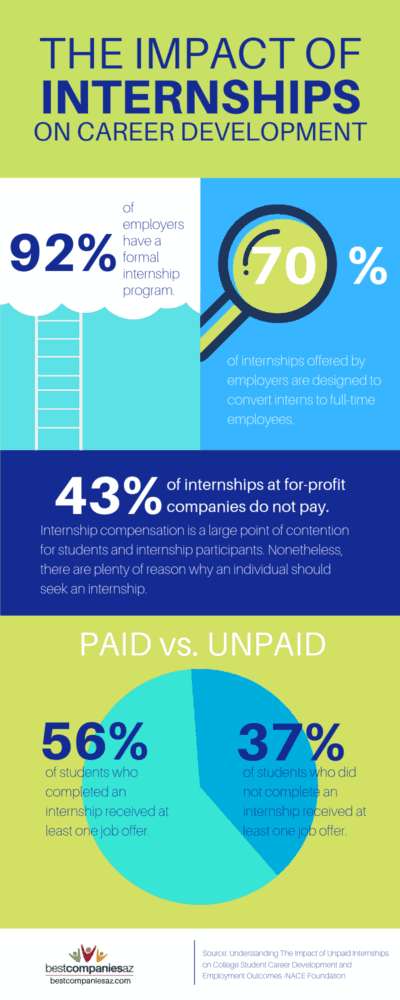
Paid internships are more advantageous to the employer, because they help the employer gain quality talent. Some companies see their paid interns as part of their staff. They are also more likely to receive a job offer after graduation. While these benefits are not guaranteed, they are more likely to occur with a paid internship than with an unpaid one.
Unpaid internships are often beneficial to the intern, but not to the employer. A study by Intern Bridge found that women are more likely to take on an unpaid internship, whereas men are more likely to opt for a paid position. Furthermore, the study noted that 67 percent of paid internships lead to a full-time job. Nonetheless, unpaid internships may exacerbate racial and economic inequalities.
It is important to consider the legal and ethical implications of an internship. For instance, the Fair Labor Standards Act defines an intern as an unpaid trainee who meets certain criteria. Likewise, New York law requires that interns be provided with transferable training. As such, employers need to be sure that they are providing an internship that will meet the requirements of the law.
Lastly, students should think about the advantages and disadvantages of both types of internships. If an internship is not going to be a stepping stone to a permanent job, it might be a waste of time and money. Similarly, the experience gained in an unpaid internship might be irrelevant.
Ultimately, the best internship is the one that fits your needs. To do this, you should decide what is the most important goal for you in an internship and focus on that.
Paying interns
Interns may provide an organization with invaluable experience, but they may also create legal issues. The US Department of Labor has issued new guidelines for unpaid internships. It requires that an intern be a primary beneficiary of the organization’s program before it is legal to pay them for an internship.
However, even if an internship is not paid, the employee is entitled to at least minimum wage. That can be a weekly payout, a lump sum, or a monthly amount, depending on the length of the position. If the intern works less than a month, the employer may be liable for health insurance benefits. Moreover, employees who work 30 hours or more per week are eligible to receive group health insurance.
An intern’s work is usually closely supervised by a regular staff member. This allows the intern to work on a wide variety of projects and gain valuable skills. Because the intern is working under the guidance of a trained professional, the employer doesn’t benefit directly from the intern’s activities. In fact, the intern may even detract from the productivity of the worksite.
Several cases have been brought against companies such as Viacom, Warner Music Group, Conde Nast, and Sony. These companies were found to have violated federal labor laws by not paying their interns. Some of the cases were settled in favor of the company, while others were not.
According to the US Supreme Court, internships cannot be viewed as a form of free labor. This is because an internship is not a means of getting a job after the internship ends. Rather, the internship is tied to an individual’s current educational program. Often, internships are offered to college students as a way to get a leg up in the business world.
Unpaid internships are becoming a hot issue in recent years. Many people believe that this practice is unfair and exploitative of young workers. While this isn’t necessarily the case, a well-established law firm, Brandon Ruiz, has been representing employees in wage disputes.
An internship can help organizations to better understand how they operate, as well as to identify potential employees. They can also teach the next generation of workers. Employers are able to improve processes and find more effective ways to hire staff. Furthermore, interns can offer fresh perspectives and give the company extra hands to tackle a new project.
However, it is important to note that the U.S. Department of Labor does have guidelines for interns, which can be used to determine if the intern is a primary beneficiary. A primary beneficiary test is a seven-point procedure that can be used to determine whether or not an intern is a “nonexempt” worker and entitled to pay. Previously, a six-point test was employed. However, the US Department of Labor has changed this test to include more factors.
They can lead to a full-time job
Getting an internship is a great way to gain experience in a career field. Internships also provide an opportunity for you to build a professional network and learn more about your passions. Eventually, you may even find yourself in a full-time position. However, the process can be difficult. In this article, we’ll cover some of the most important steps to take during an internship to ensure you have a smooth transition into a full-time position.
The first step is to set yourself up for success. You’ll need to show your dedication and motivation. This includes being on time, showing up to work and getting things done. When working, be mindful of how you spend your time and make sure you use the 80/20 rule. It’s a good idea to keep track of your wins and accomplishments during your internship.
Another important step is to seek feedback from your supervisor. Obtaining and implementing feedback will demonstrate your maturity and willingness to learn. For example, a performance evaluation might list your most valuable accomplishments and weaknesses. Make it a point to implement all suggestions you receive. By doing this, you’ll demonstrate your desire to learn and provide the best possible service to your employer.
Aside from learning more about your passions, you’ll be able to see if a particular firm is a good match for you. Especially in a competitive job market, it’s important to get the right kind of experience. Whether that means taking on an extra role, or learning more about the business you’re interested in, you’ll get the knowledge you need to succeed in the real world.
If you are able to complete a project that demonstrates your ability to perform more complex aspects of the job, you’ll have a leg up on the competition. One good way to show this is to complete advanced projects during your internship. Depending on the nature of the assignment, these tasks might be ongoing or have a specific deadline.
Although an internship is an excellent way to develop your skills, it’s not for everyone. Full-time work offers more flexibility and can provide a higher pay packet. Some companies may extend full-time offers to their top interns. Others may require you to work more hours or report to a higher-level coworker. Whatever the case, a successful internship will give you the insight you need to determine if you want to pursue a full-time position with that company.
The right internship can help you land a coveted full-time position with a top-notch company. But how do you go about making the transition? Here are four tips for making the leap.
The most important thing is to find an internship that matches your goals. Choose a project that will allow you to grow professionally, while also having fun. This will increase your chances of landing a full-time job with a company that you will enjoy.